
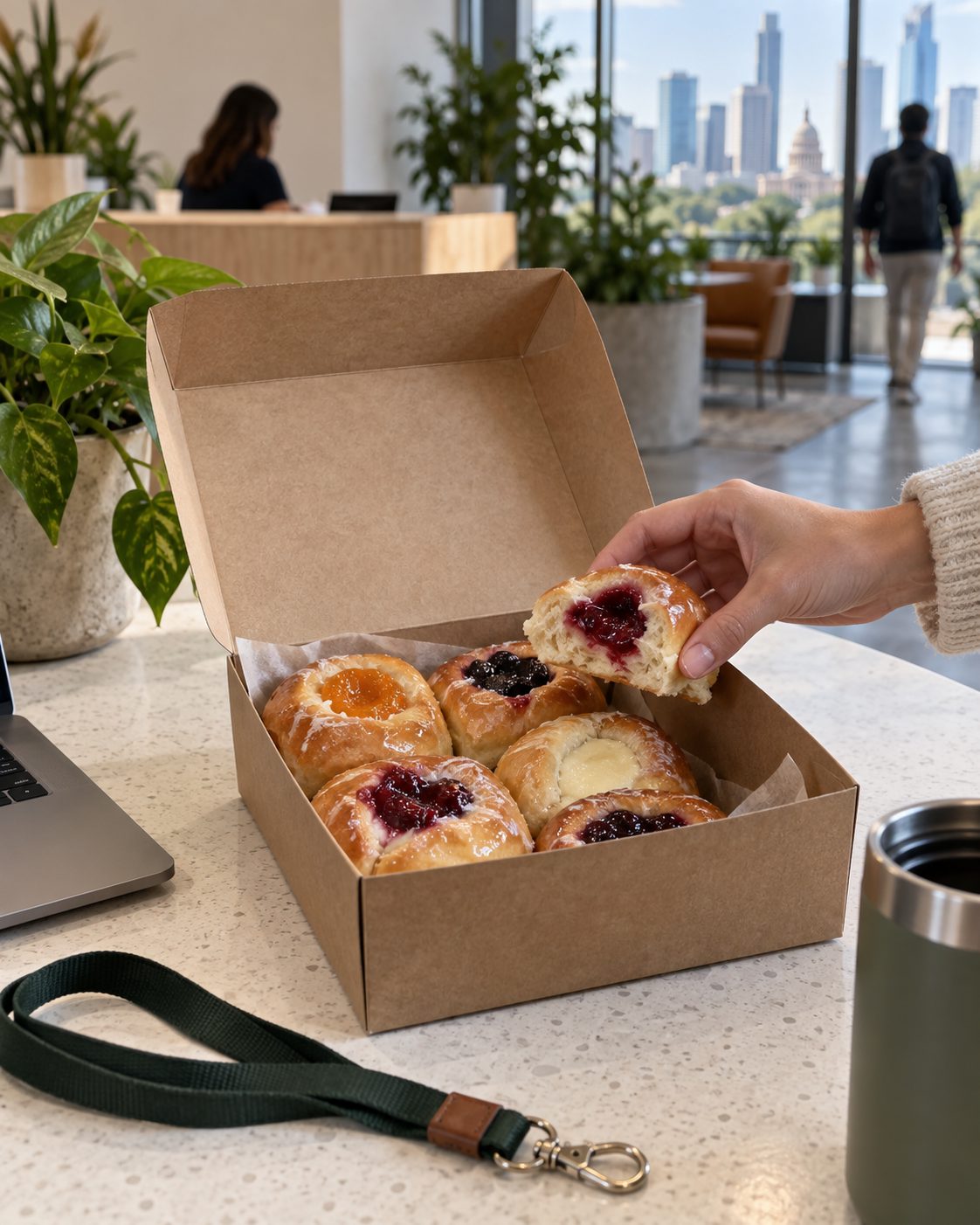
Lunch and coffee for the people who are at their desks every day.
Office coffee service, breakroom micromarkets, office lunch delivery and staff cafeteria management for Austin workplaces of 25 to 600 people. It all comes out of our own commissary on Market Street and lands on one invoice. Order lunch by 10:00 and it is on your floor by 12:00, with a name on every box.

A daily employee lunch program lives or dies on two times
Everything in our week bends around the lunch cut-off and the delivery window. Get those two right five days running and nobody in the office thinks about food again, which is the point.
-
Order cut-off
10:00
Teams order from the week's menu until ten. At 10:01 the count goes to the pass and the kitchen cooks to it, not to a guess.
-
On your floor
12:00
Crates leave at 11:40 and the boxes are on your floor by noon, one per person, name on the lid.
-
Running since
2014
Eleven-plus years of weekday routes around Austin. Around 40 of us now: cooks, drivers, technicians and two cafeteria managers.
Milk is the thing that goes wrong. We carry it on the route, not by courier.
Four services, one kitchen and one route behind them
Take one or take all four. Each has its own room on the services page, with the equipment we install, how the price is built and who it does not suit.
- 01 Office coffee points A commercial bean-to-cup machine and a fresh-milk fridge, cleaned at 07:15 and descaled every fortnight.
- 02 Breakroom micromarkets An unattended micro market for offices: open fridge, dry shelf, card kiosk. Restocked and date-checked every weekday morning.
- 03 Office lunch delivery A weekly rotating menu from our commissary. Order by 10:00, delivered by 12:00, labelled per person.
- 04 Cafeteria operation We staff and run the canteen you already have: cooks, menu, purchasing, hygiene logs and the till.
The route runs on a fixed clock
Same stops in the same order, and the same person at your door. The clock starts at 06:30 in our commissary and ends when the last crate is back and the waste sheet is signed.
-
06:30
Commissary opens
Lights on at Market Street. The first cook starts bread and bowls: grains on, roasting trays in, dressings made the same morning. The day's milk and pastries are loaded into the route vans before seven.
-
07:15
Coffee points cleaned and dialled in
Before your first people arrive, the route person flushes the milk lines, empties the grounds, wipes the trays and pulls a test shot. If the grind has drifted, it gets corrected there, not after the first complaint.
-
09:00
Micromarkets restocked, dates checked
Every item in the fridge is checked against its date. Anything past it comes out and goes on the waste sheet. Then the gaps get filled from the van, and the kiosk count is reconciled against what left the shelf.
-
10:00
Lunch order cut-off
Orders close. The count lands on the pass and the kitchen plates to it. Late orders after ten go on the next day, because cooking to a guess is how kitchens waste food and run short at the same time.
-
11:40
Insulated crates out the door
Boxes are packed per person, name on the lid, hot and cold kept in separate crates. The vans leave in route order so the furthest office is not the one waiting.
-
12:00
Lunch on your floor
The driver brings the crates up to the floor you gave us, not the loading dock. Your office contact signs for the count and the boxes go on the table.
-
14:30
Crates collected, waste logged
Empty crates come back to the commissary for washing. Leftovers and pulled market stock are weighed and logged, and the log shapes the next week's order quantities.
The same person fills your fridge every morning
A lot of office pantry services rotate drivers. We do not. Clients learn the name of the person who restocks their market, and that person learns which floor drinks oat milk.
We started in 2014 with one van, one coffee machine contract and a rented kitchen. The commissary on Market Street came later. Today about 40 people work here: cooks who start at 06:30, route drivers who each own a fixed run, technicians who came up as baristas and know what a sour shot tastes like, and two cafeteria managers who run staff canteens for clients on site.
The one-person-per-route model costs us flexibility. When a route lead is off, a named cover who has ridden that route before takes it, not whoever is free. It is slower to staff that way. It is also the reason a fridge that ran low on Tuesday gets more yogurt on Wednesday without anybody filing a ticket.
The mistake we see most often at offices that switch to us: the old provider delivered coffee and snacks from a warehouse and lunch from a separate caterer, and nobody owned the breakroom. Two vendors, and each one blamed the other. With us the milk order, the market stock and the lunch count come from one kitchen and are billed together.
- Started
- 2014, Austin
- People
- Around 40: cooks, route drivers, technicians, two cafeteria managers
- Commissary
- 46 Market Street, Suite 4, Austin. Opens 06:30 weekdays
- Office size we suit
- Roughly 25 to 600 people
- Lunch window
- Order by 10:00, delivered by 12:00
- Coffee descaling
- Every fortnight, on the route
- Market checks
- Every weekday morning, dates logged
- Invoices
- One, covering every service you take
More on the kitchen and the people: the about page covers how the commissary runs and what we buy from Texas suppliers.
We quote on a basis, then fix it after a site visit
No published rate card, because a coffee point for 30 people on one floor and one for 400 across three are different jobs. Here is what each quote depends on.
| Office coffee point | Monthly equipment and service fee, plus beans and milk per cup served. Quoted after we have seen the room, the water supply and the headcount. |
|---|---|
| Micromarket | Employees pay per item at the self-checkout kiosk. Host terms, including any company subsidy, are set by headcount at the site survey. |
| Office lunch delivery | Per plate. Invoiced weekly to the company, or paid by each employee when they order. |
| Cafeteria operation | Monthly management fee plus food cost, on an open book you can read line by line. |
How an office starts with us
- You send the headcount and the floor
By the form below, phone or email. That is enough for a first answer, usually the same working day, on whether a market or a coffee point makes sense first.
- Site survey, about 45 minutes
We walk the breakroom, check the water line and power for a machine, measure fridge space and find out where lunch crates can come up. Nothing is signed at this visit.
- Written quote on the basis above
Within a week of the survey. It names the equipment, the route stop time and the route person who will cover your office.
- Install and first stock
A coffee point goes in on one morning. A micromarket takes a day to fit and a day to stock. Lunch can start the Monday after you sign.
- Review after four weeks
We look at the waste log, the sales and the lunch counts with you and adjust. Most offices change the market mix at this point, rarely the coffee.
Weekdays only, and no one-off events.
-
Banquets and galas
A kitchen that chases a Saturday gala shows up tired on Monday. Our cooks do one job, and it is your weekday lunch.
-
Weekend events
The commissary closes on Friday afternoon. The one exception is a holiday lunch for a team we already feed every day, on a weekday.
-
Single-drop party trays
If you want one sandwich platter for one meeting, a caterer will do it better and cheaper. We are built for the daily run.
-
Machines we cannot service
We only install coffee equipment our own technicians can strip, descale and repair. No leased black boxes waiting three days for a callout.
We do not do weddings. The kitchen that cooks your Tuesday lunch is not going to spend Saturday on a gala.
The questions office managers ask on the first call
Anything not here, ask it in the form or on the phone. We would rather answer a blunt question now than after a contract.
How small an office do you take on?
We work with Austin offices of roughly 25 to 600 people. Below 25, a daily route stop rarely pays for itself, and we would rather say so than run it badly. A small team can still take lunch delivery if the building sits on an existing route.
Do we have to take all four services?
No. Most offices start with one, usually a coffee point or lunch delivery. The advantage of adding a second later is that it rides on the same route, with the same person, on the same invoice.
What happens if lunch is late or the coffee point runs dry?
Report it the same day and it is credited on your next invoice. The exact wording of that guarantee is in our service terms.
How do you handle allergies and dietary needs?
Tell us at ordering. Every box carries a name and the dish, and the kitchen plates special requests to that name. Our commissary handles nuts, gluten, dairy and sesame in the same room, so we never sell anything as allergen-free.
Will you cater our holiday party?
Only for teams we already feed every day, and only on a weekday. We do not take one-off events, weddings or galas, for the reason on the paper band above.
Ask about your office
Tell us the headcount and the floor. We will tell you whether a market or a coffee point makes sense first, and whether your building sits on a route we already run.
- ReplyA person from the commissary, usually the same working day
- VisitA 45-minute site survey before any quote
- Phone+1 (393) 555-3266
- Email[email protected]