
Coffee, market, lunch and canteen, run by one kitchen on one daily route.
Office coffee service, breakroom micromarkets, office lunch delivery and corporate cafeteria management for Austin workplaces. Each has its own room below: how it runs, what we install, how the price is built, and the offices it does not suit.
Office coffee points
A commercial bean-to-cup coffee machine for your office, a fresh-milk fridge beside it, and a person who cleans it at 07:15 every weekday.

The machine and the 07:15 visit
We install one or more commercial bean-to-cup machines in your breakroom, plumbed to the water line where the building allows it, with a small refrigerated milk unit beside each one. Staff press a button and get an espresso, a flat white, a long black or a hot chocolate. No capsules and no pods.
The route person stops every weekday morning before your first people arrive. They empty the grounds, flush and clean the milk system, wipe down, refill beans, swap milk and top up cups and lids. Then they pull a shot and taste it. If the grind has drifted with the weather, it gets corrected on the spot.
Milk is the thing that goes wrong on every office coffee contract we have taken over. Couriers leave it in a lobby at 10:00. We carry it on the route van, chilled, and put it in the fridge ourselves.
Maintenance nobody sees
A machine that makes 180 cups a day needs descaling more often than the manual says. We do it every fortnight, whatever the manual says, because Austin water is hard and scale is what kills pumps and boilers. Brewer units come out for a deep clean on the same cycle. Gaskets and seals are replaced on a schedule, not after they leak across your counter.
When a machine faults, the technician on that route comes, not a third-party engineer booked for next Thursday. We only install models our own people can strip down and repair, which is why we do not lease out whichever brand is cheapest this quarter.
Beans and milk
A medium roast espresso blend as the house bean, with a second hopper for decaf on larger machines. Whole milk and one plant milk by default; oat is the one most offices ask for. If your floor drinks twice as much oat as whole, the route person notices by week two and changes the order.
Offices a coffee point suits
- Offices of 25 people and up, where a domestic machine is already failing by 11:00.
- Teams that drink milk coffee and are tired of cartons going off in a shared fridge.
- Floors with a water line or a sink within a few feet of the counter.
When a coffee point is the wrong call
- A team of eight. A good drip brewer and a grinder will serve you better and cost far less.
- Offices that want a staffed barista bar. We run self-serve machines, not a coffee shop.
Breakroom micromarkets
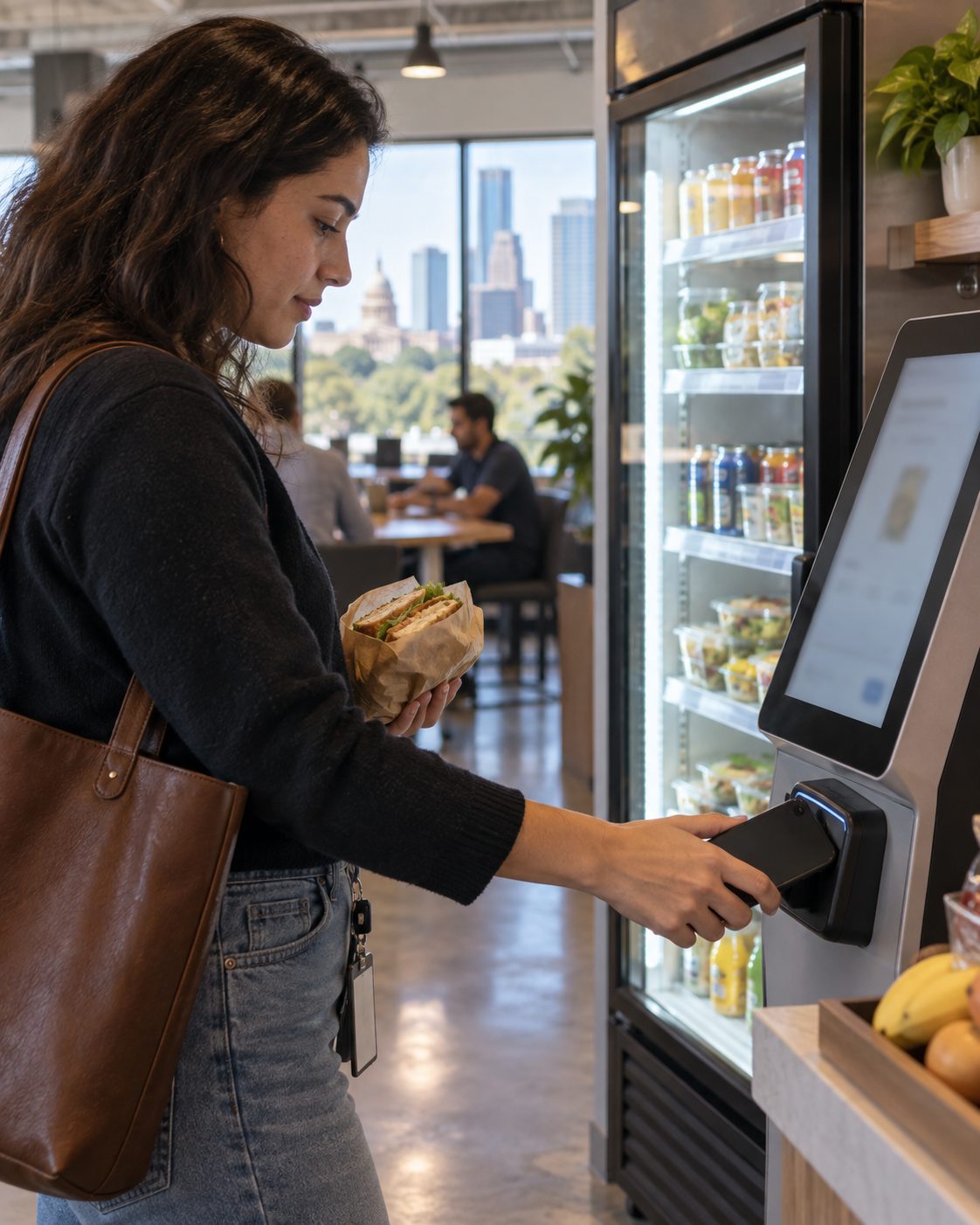
An unattended micro market for offices: open fridge, dry shelf and a card kiosk. Staff tap and walk off. We check every date every weekday morning.

Fridge, shelf, kiosk and the morning restock
A breakroom micromarket replaces the vending machine and the office snack drawer. We fit an open glass-door fridge, a dry-goods shelf and a self-checkout kiosk that takes cards and phones. Employees pick what they want, scan it and pay. Nobody staffs it. Nobody needs to.
The fridge carries what our commissary makes the same morning or the day before: grain salads, wrapped sandwiches, yogurt and granola cups, cut fruit, bottled cold brew. The shelf carries snacks, nuts, bars and a few staples for people who skipped breakfast. Kolaches and morning buns go in on the early stop for offices that want them.
The fridge gets checked every weekday morning. Anything past its date comes out, and we log it. That log, together with what the kiosk sold, decides the next day's stock for your market specifically. The office with the cyclists eats twice the protein boxes; the office on the ninth floor never touches egg salad. After a month, the mix looks nothing like the one we started with.
Losses and trust
People ask about theft. In an office where staff badge in, shrinkage is small, and we see it in the kiosk reconciliation each morning. If a market runs persistently short, we talk to the host about a camera over the kiosk or a moved location before we talk about anything else. We have not had to pull a market for it.
Space and power
A standard market needs a stretch of wall roughly 8 feet wide, one dedicated power outlet for the fridge, another for the kiosk, and a Wi-Fi or wired connection for card payments. The site survey confirms all of it before anything is ordered.
Offices a micromarket suits
- Offices of roughly 60 or more, where there is enough daily footfall to keep the fridge turning.
- Buildings with no food within a short walk, or shifts that run past normal lunch hours.
- Employers who want an office pantry service without buying and throwing out snacks themselves.
When a market wastes more than it sells
- Offices where half the team works from home most days. A fridge that sells 12 items a day wastes more than it sells.
- Breakrooms open to the public. The honor system needs a badge-controlled floor.
The fridge gets checked every weekday morning. Anything past its date comes out, and we log it.
Office lunch delivery
Order by 10:00. It is on your floor by 12:00, with a name on every box. A daily employee lunch program cooked in our own commissary, not bought in.

From the 10:00 cut-off to your floor
Every Thursday we publish the next week's menu: five working days, several plates a day, always including meat, fish or a vegetarian main, and a lighter grain bowl. Staff order individually through the ordering link or the office contact sends a single count. Orders for the day close at 10:00 sharp.
At 10:01 the count goes to the pass. The kitchen plates to the number, packs each box with the person's name and dish on the lid, keeps hot and cold in separate insulated crates, and the vans leave at 11:40. The driver brings the crates to the floor, not the loading dock, and the office contact signs for the count. Crates are collected at 14:30.
What goes in the box
Roast chicken thighs with charred broccolini and farro. Braised black beans with rice, pico and a lime wedge. Smoked brisket with pickled slaw on a potato roll on Fridays, because it is Texas. Grains are cooked from dry in the morning, dressings are made in the kitchen, and bread for sandwiches comes out of our own oven at 06:30. We buy produce from Texas growers when the season allows; the about page covers how we buy.
The menu rotates on a four-week cycle with seasonal swaps. Nobody in your office should eat the same plate twice in a month unless they order it.
Late orders and changes
An order after 10:00 goes on the next working day. We do not add a late plate to the van, because cooking to guesses is how kitchens end up short and wasteful in the same week. Headcount changes for the whole office, such as an all-hands or a half-empty Friday, need 24 hours' notice.
Offices lunch delivery suits
- Employers running an employee meal program as a daily benefit, not a Friday treat.
- Offices with a room to eat in but no kitchen to cook in.
- Teams tired of five different delivery apps and one person always waiting in the lobby.
When to call a caterer instead
- A one-off lunch for a client meeting. Call a caterer; we are built for every day, not one day.
- Anyone who needs a certified allergen-free kitchen. Ours handles nuts, gluten, dairy and sesame in one room.
Cafeteria operation
You have the canteen. We run it: the cooks, the menu, the purchasing, the hygiene logs and the till. Corporate dining services in Austin on an open book.

Taking over your canteen
This is for companies that already own a staff cafeteria with a working kitchen and want someone else to run it well. We take over the operation: we hire and schedule the cooks and counter staff, write the menu, buy the food, keep the temperature and cleaning logs, and run the till. One of our two cafeteria managers is assigned to your site and answers to your facilities lead.
The menu is cooked on site from raw ingredients. The commissary backs it up with bread, dressings and baked goods on the morning route, and covers a service if your kitchen has an equipment failure. That backup is the reason we can run a canteen with a smaller on-site team than most operators.
Open book
You see what we pay for food. Every supplier invoice for your site is available to you, and the monthly statement shows food cost, labour and our management fee as separate lines. If your food cost jumps because beef went up, you see the beef invoice. We do not mark up ingredients and hide it in a per-cover price.
The first 30 days
Week one, we watch: how many covers, at what times, what sells out, what goes in the bin. Week two, we keep your existing menu but change purchasing and prep. Weeks three and four, we bring in our menu, a few dishes at a time. Existing kitchen staff are interviewed first for our roles; a canteen that changes every face at once loses its regulars.
Sites cafeteria operation suits
- Sites of a few hundred staff with a working kitchen that is under-used or badly run.
- Facilities teams who want to see the food bill line by line.
Canteens we will not take on
- Buildings without a kitchen. We do not design or build canteens; lunch delivery is the answer there.
- Canteens that also host weekend events or evening functions. We run the weekday service only.
Which one to start with, by headcount
Tell us the headcount and the floor. We will tell you whether a market or a coffee point makes sense first. This is roughly what we say on the phone.
| 25 to 60 people | A coffee point, and lunch delivery if your building is on an existing route. A market rarely turns over fast enough at this size. |
|---|---|
| 60 to 200 people | Coffee point plus micromarket on the same morning stop. Add lunch delivery once the market shows what people actually eat. |
| 200 to 600 people | Several coffee points, one or two markets, and a daily lunch program. If you have a kitchen, look at cafeteria operation instead of delivery. |
| Any size, with a canteen | Cafeteria operation, with coffee points on the other floors fed from the same route. |
The reason to put more than one service with us is not a bundle discount. It is that one person walks your breakroom every morning and sees all of it. They notice the market is out of oat milk because the coffee point used it all, and they fix both from the same van. Two vendors would each blame the other.
Everything lands on one monthly invoice with a line per service. Add or drop a service with 30 days' notice. The full wording, including the same-day credit for a missed delivery or an empty coffee point, is in our service terms.
A machine that makes 180 cups a day needs descaling more often than the manual says. We do it every fortnight.
One conversation, one site survey, then a written quote
Nothing on this page is a binding price. We quote on the bases above after 45 minutes in your breakroom, usually within a week of the visit.
- Send the headcount, the floor and what you have now
Through the contact form, by phone on +1 (393) 555-3266 or to [email protected].
- We visit and measure
Water, power, wall space, lift access for crates, and where the fridge will not block a fire door.
- You get the quote and the name of your route person
Start dates are usually the Monday after signing for lunch, and within two weeks for a coffee point or market.